De Minimis Is Gone for Good. What Shopify Sellers Ship Now.

Updated: Sep 23
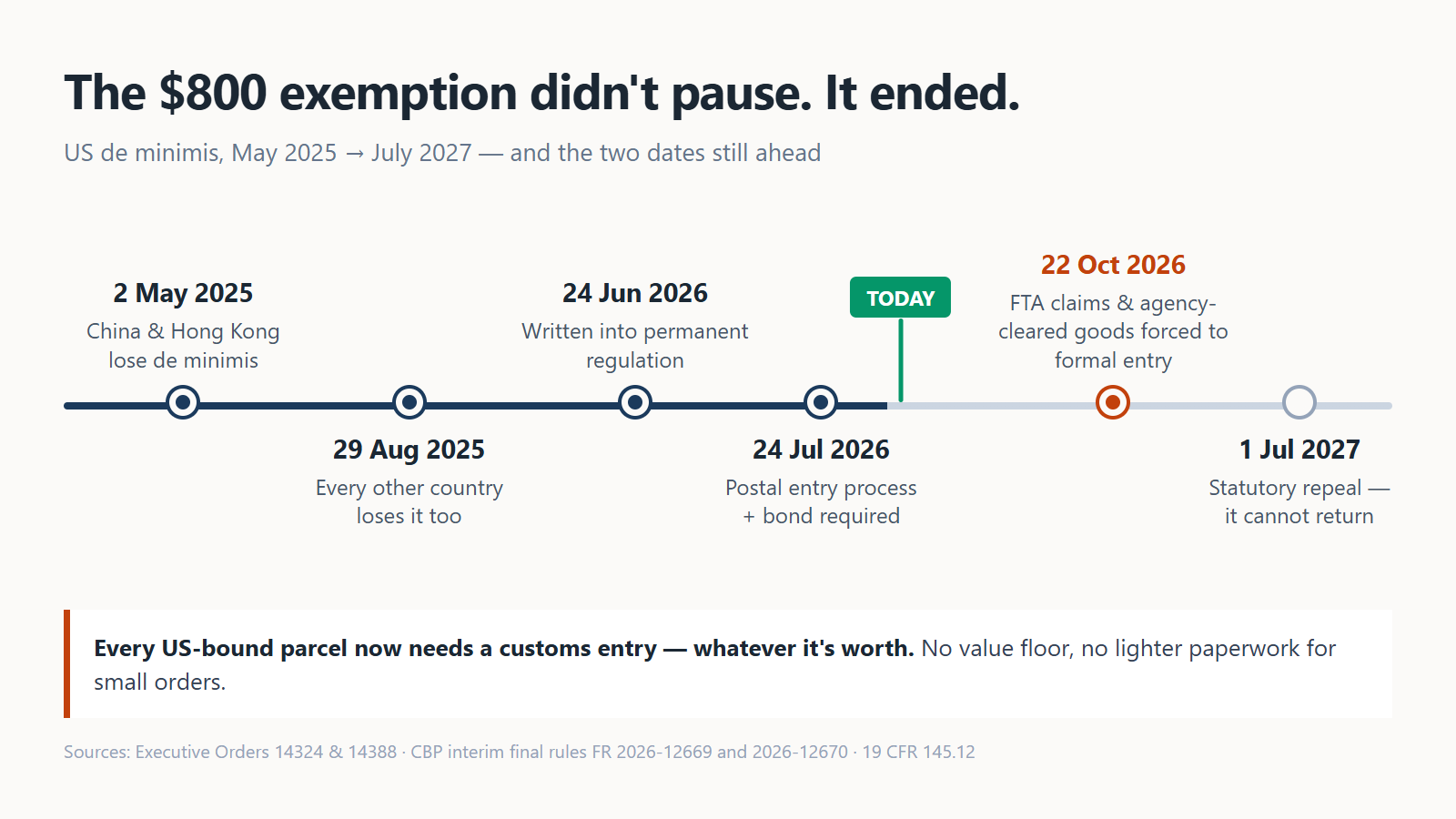
If you have been treating the end of the $800 de minimis exemption as a temporary disruption, that position closed on 24 June 2026. On that date US Customs and Border Protection issued two interim final rules that moved the suspension out of executive-order territory and into permanent regulation. A statutory repeal follows on 1 July 2027.
Which means every parcel you send into the United States now needs a customs entry, whatever it's worth. A $14 phone case gets the same paperwork treatment as a $1,400 laptop. Not a lighter version. The same one.
Most of the coverage so far has been about money — landed costs, margins, whether to raise prices. That part is largely settled by now. The part still breaking merchants is the paperwork, and there's one more date on the calendar before the year is out.
What actually changed with de minimis
De minimis was the rule that let shipments valued at $800 or less enter the US duty-free with minimal paperwork. It ended for China and Hong Kong on 2 May 2025, and for every other country on 29 August 2025 under Executive Order 14324. Since 24 June 2026 it has been permanent regulation, so every US-bound parcel needs a customs entry regardless of value.
The 24 June 2026 rules did two separate things. The first covers everything arriving by ocean, air, truck, rail, or express consignment — effective immediately on 24 June. The second, the postal rule, covers international mail and creates a new postal informal entry process, effective 24 July 2026. If you ship some orders by courier and some by post, both rules apply to you, on different dates, with different mechanics.
The practical result is the same either way. There is no value floor anymore. Every shipment is entered, classified, and assessed.
The EU went the same way on 1 July 2026, when its €150 duty exemption ended — here's what changed there, and what's next on 1 November.
Why waiting it out stopped being a strategy
Plenty of merchants spent the past year assuming this would reverse. That was a defensible read while it was an executive order — orders get rescinded, and this one had been challenged.
Regulation is different. CBP has now written the suspension into the Code of Federal Regulations, and Congress has a statutory repeal scheduled for 1 July 2027. Undoing it would take a new rulemaking, and the repeal removes the legal basis entirely. There is no version of the next eighteen months where the $800 threshold comes back.
So if your plan was to keep your old product data and wait: the waiting is the expensive part. Every shipment going out with a vague description or a guessed tariff code is accruing risk right now.
What every US-bound shipment now needs
Here is the operational core of it. For each shipment, the filer has to supply:
Field | What customs expects | Where merchants get it wrong |
Merchandise description | Plain technical language for what the item physically is | Marketing names — your product name doesn’t matter to customs. “Aurora Wrap” is not a description; “women’s scarf, 100% merino wool” is |
10-digit HTSUS classification | The full US tariff code, not a 6-digit HS stem | Copying the supplier’s code, or reusing one code across a whole catalogue |
Country of origin | Where the goods were produced, per line item | Using the ship-from address instead of the manufacturing country |
Shipment value | The transaction value in the declared currency | Zero-value or “sample” declarations, which get rejected outright |
Bond number | For postal informal entries — see the next section | Not having one, and finding out at the border |
The 10-digit code is the one that catches people. A 6-digit HS number is internationally harmonised; the last four digits are US-specific, and they're what sets your duty rate. Apparel and textiles are the worst offenders here, because material-specific rates can differ by five to ten percentage points between codes that look nearly identical.
There's a trap in Shopify itself here. The main HS code field under Shipping holds the 6-digit global code. Shopify does let you add the 10-digit US code on the same product page (the ⋯ menu → Add HS codes by country/region, available once the US is one of your markets), but it's optional and nothing prompts you to do it. So if you only filled in the main field and assumed you were covered, you're carrying a 6-digit code into a process that wants ten.
Country of origin has a similar trap. It's where the goods were made, not where your warehouse is. If you're a UK store shipping a product manufactured in Portugal, the origin is Portugal.
This is where a tool like Customs Buddy earns its place — it generates the commercial invoice per order with the description, classification, origin, and value already on it, so the data exists before the parcel does rather than getting assembled by hand at 6pm. To be clear about the boundary: it produces the document. It does not file your entry and it does not provide your bond. Those stay with you or your broker.
If you're setting this up from scratch, our guide to customs automation for Shopify stores walks through the whole pipeline.
If you ship by post, July changed things again
The postal rule is stricter than most merchants realise, and it took effect on 24 July 2026.
Mail shipments valued at $2,500 or less, in HTSUS chapters 1 through 97, now go through a new postal informal entry process. Three things about it matter:
Only certain parties can file. The owner, the purchaser, or a licensed customs broker. Third parties are no longer permitted to file postal informal entries. If you had an arrangement where some intermediary handled this for you, check right now whether they still legally can.
A bond is required. Filers must obtain a basic importation and entry bond — either a single transaction bond or a continuous one, on the conditions in 19 CFR 113.62 — and shipments will not be released until CBP receives it. This is the one that strands inventory. A bond is not something you arrange in an afternoon after your parcels are already sitting at a facility.
Every shipment carries fourteen data elements. Not four. The postal informal entry requires: filer code, bond number, description of merchandise, country of origin, all applicable 10-digit HTSUS classifications, quantity/weight, duty rate, value, total duty owed, carrier, flight or conveyance number, tracking number, arrival port, and arrival date.
Half of those come from the carrier and the shipment itself. The other half — description, origin, classification, value — come from your product data, and they're the half that has to be right before the parcel ever moves.
Duties are paid through Pay.gov no later than the 7th day of the month following the shipment's arrival.
Some goods can't use this process at all and need a full formal entry: anything over $2,500, quota goods, anything subject to antidumping or countervailing duties, alcohol and tobacco, goods needing another government agency's clearance, and anything under HTSUS chapters 98–99 or claiming duty-free treatment under those chapters or a free trade agreement.
One more thing on postal: the flat per-item duty option that ran through the earlier transition is gone. Postal duty is now assessed on value, like everything else.
The de minimis dates: one just passed, one still ahead
22 September 2026 — CBP's voluntary test of Entry Type 13 went live. It's a new electronic informal entry type built for mail shipments valued at $2,500 or less, and it lets importers and brokers submit shipment-level data electronically: classification, origin, value, duty calculation, bond details. It ran in the ACE certification environment from July and moved to production on 22 September. It's voluntary for now, and worth joining early if you ship meaningful postal volume, because the manual spreadsheet alternative does not scale.
22 October 2026 — the grace period ends on two categories of goods. When CBP wrote the postal rule, two of the mandatory-formal-entry categories got a 120-day delayed compliance window. That window closes on 22 October. From that date, two kinds of mail shipment can no longer use the postal informal entry process at all:
Goods requiring clearance from another government agency — FDA, USDA, FWS and the rest. Cosmetics, supplements, food, anything with animal or plant content.
Goods under HTSUS chapters 98 and 99, or claiming duty-free treatment under a free trade agreement.
That second one deserves a hard look. If you've been claiming USMCA or another FTA preference on mail shipments, from 22 October that claim forces a formal entry. Some merchants will find the duty saving no longer covers the filing cost, and the right answer is to stop claiming preference on small parcels. Work out which side of that line you're on before October, not after.
What to do this month
Audit your HS codes. Pull your product catalogue and check that every item has a 10-digit HTSUS classification, not a 6-digit stem and not one code shared across variants. Use the official USITC tariff database. If a product is genuinely ambiguous, a CBP binding ruling settles it permanently.
Set country of origin per product, not per order. It belongs in your product data as a field, alongside weight and material. Doing it at pack time guarantees it will eventually be wrong.
Rewrite your product descriptions for customs. Keep your marketing names on the storefront. The invoice needs material, function, and form.
Confirm who files your entries. Especially for postal. If it's a third party, that may no longer be permitted, and you need to know before a shipment tests it.
Sort out the bond now if you ship by post and don't have one. Shipments aren't released without it.
Check the 22 October categories against your catalogue. If you ship anything needing FDA, USDA or similar clearance by post, or you claim FTA preference on mail shipments, that route closes in October. Decide now whether to move to a courier, absorb formal entry, or drop the preference claim.
Automate the invoice. Once the four fields live in your product data, generating a compliant commercial invoice per order should be a background process, not a task.

FAQ
Does this apply to shipments under $800? Yes. That's the entire change. There is no longer a value below which a shipment skips the entry process.
Do I need a customs broker now? Not necessarily. Informal entry doesn't require a broker. But for postal informal entries, only the owner, purchaser, or a licensed broker may file — so if you were relying on someone else, you may need one.
Is de minimis coming back? No. It's regulation now, with a statutory repeal on 1 July 2027.
Does switching to DDP fix this? DDP changes who pays the duty and when the customer finds out. It doesn't remove the entry, and it doesn't fill in your tariff codes. It's a good move for conversion. It isn't a compliance answer.
What about gifts? The suspension hit the $800 commercial exemption. The separate exemptions for bona-fide gifts and for personal or household articles accompanying travellers are untouched. That does not help a store, though — a bona-fide gift is person-to-person, not a merchant shipping to a paying customer. Don't label commercial orders as gifts.
The exemption isn't coming back, and the paperwork isn't optional. The merchants handling this well aren't the ones with the best duty strategy — they're the ones whose product data was already clean enough to generate a correct invoice for every order, automatically. Customs Buddy does that part for Shopify stores.

